MOTS-c Mitochondrial Peptide
A 16-amino-acid peptide encoded by the mitochondrial 12S rRNA gene, discovered as a signaling molecule that regulates metabolic homeostasis and insulin sensitivity.
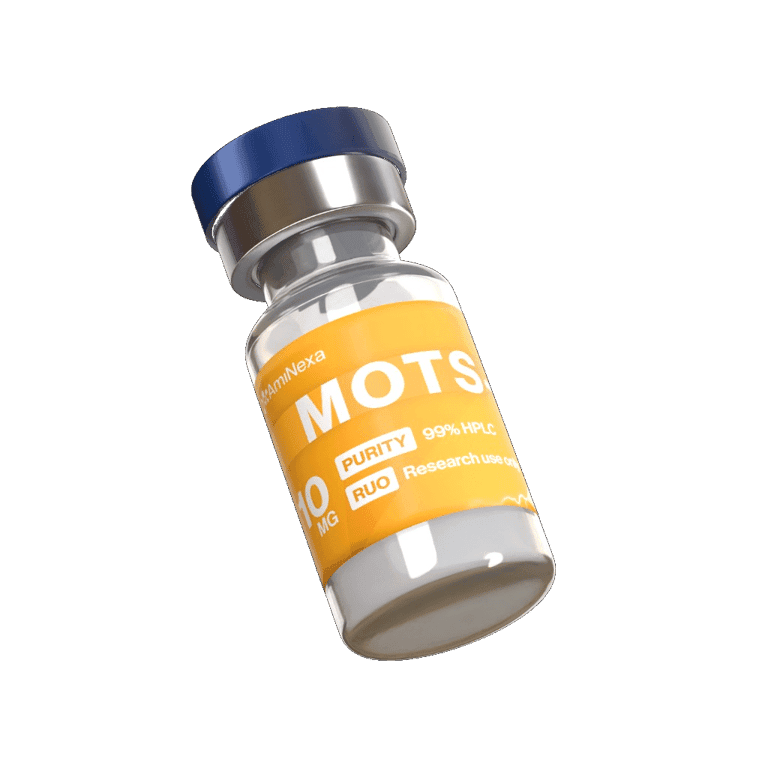
How MOTS-c Works
AMPK Activation
MOTS-c activates AMP-activated protein kinase (AMPK), the master cellular energy sensor, through accumulation of the folate cycle intermediate AICAR. This triggers downstream metabolic reprogramming favoring glucose uptake and fatty acid oxidation.
Folate-Methionine Cycle
MOTS-c targets de novo purine biosynthesis by inhibiting the folate cycle, leading to AICAR accumulation. This unique mechanism connects mitochondrial signaling to one-carbon metabolism and epigenetic regulation.
Nuclear Translocation Under Stress
Under metabolic and oxidative stress, MOTS-c translocates to the nucleus where it interacts with stress-responsive transcription factors, representing a novel form of mitochondria-to-nucleus retrograde signaling.
MOTS-c is one of the first identified mitochondrial-derived peptides (MDPs) that acts as a retrograde signal from mitochondria to the nucleus, activating AMPK and folate-methionine metabolism.
Clinical Research
The Mitochondrial-Derived Peptide MOTS-c Promotes Metabolic Homeostasis and Reduces Obesity and Insulin Resistance
Lee C, et al.
First identification of MOTS-c as a mitochondrial-encoded signaling peptide that regulates insulin sensitivity and metabolic homeostasis through AMPK-dependent pathways.
MOTS-c: An Equal Opportunity Insulin Sensitizer
Kim KH, et al.
Demonstrated that MOTS-c improves glucose clearance and insulin sensitivity in aging models, with nuclear translocation as a key mechanism for stress-adaptive gene regulation.
Research Applications
AMPK pathway
Retrograde signaling
Glucose uptake
One-carbon metabolism
Molecular Profile
Safety Profile
MOTS-c is an endogenous peptide encoded by the mitochondrial genome. As a naturally circulating molecule, it has a favorable preliminary safety profile in preclinical models, though human clinical data remains limited.
Endogenous origin suggests favorable tolerability
Metabolic effects are more pronounced in insulin-resistant models
Fasting state at administration may amplify glucose-lowering effects
Monitor glucose in fasted experimental subjects
Consider fed-state administration for initial tolerance assessment
Track AMPK activation as a pharmacodynamic marker
Limited long-term safety data in mammalian models
Potential for hypoglycemia in combination with other insulin-sensitizing agents
Nuclear translocation under stress may affect gene expression in unpredictable ways
Not evaluated in models with pre-existing mitochondrial dysfunction
Frequently Asked
Ready to begin research?
Access MOTS-c through the AmiNexa catalog. All compounds ship via cold-chain transit with batch-specific Certificate of Analysis.
View MOTS-c Product
Important Research Notice
Not for human consumption. This product is sold exclusively for research and educational purposes. It is not intended to diagnose, treat, cure, or prevent any disease.
All clinical trial data and research findings presented on this page are sourced from peer-reviewed journals and official publications. They are provided for educational reference only and should not be interpreted as medical advice or product claims.
By purchasing this product, you confirm that you are a qualified researcher and will use it in accordance with all applicable laws and regulations.