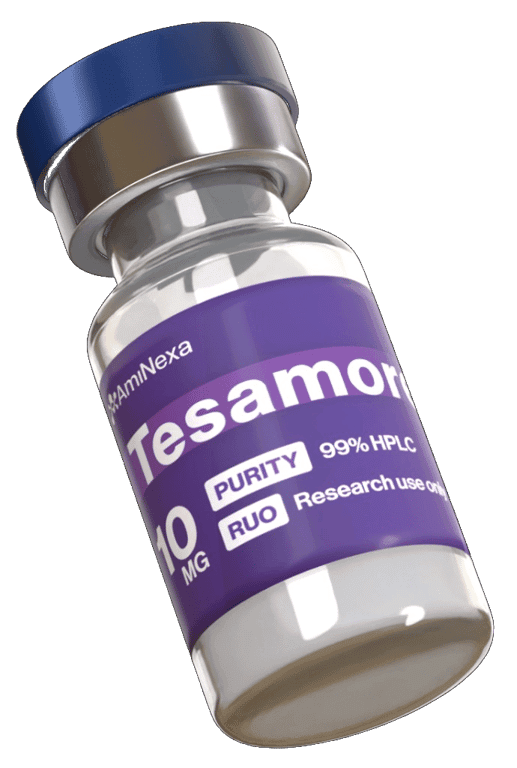
Tesamorelin (GHRH Analog)
A synthetic analog of growth hormone-releasing hormone (GHRH) with a trans-3-hexenoic acid modification, studied for pituitary-axis signaling and GH secretion dynamics.
How Tesamorelin Works
GHRH Receptor Agonism
Tesamorelin binds to GHRH receptors on anterior pituitary somatotrophs, activating Gs-coupled adenylyl cyclase and raising intracellular cAMP. This stimulates growth hormone synthesis and secretion in a pulsatile pattern.
IGF-1 Axis Stimulation
GH released via GHRH receptor activation drives hepatic IGF-1 production, activating the GH/IGF-1 axis. This cascade regulates tissue growth, protein synthesis, and metabolic substrate utilization in research models.
Feedback-Preserving Design
Unlike exogenous GH, tesamorelin works through the endogenous receptor pathway, maintaining somatostatin-mediated negative feedback. This preserves physiological GH pulsatility and prevents receptor desensitization in longitudinal studies.
Tesamorelin stimulates pulsatile GH release through the endogenous GHRH receptor, preserving physiological feedback mechanisms — a distinction from direct GH administration.
Clinical Research
Metabolic effects of a growth hormone-releasing factor in patients with HIV
Falutz J, et al.
Tesamorelin significantly reduced visceral adipose tissue and improved lipid profiles while preserving subcutaneous fat, demonstrating selective metabolic effects through the GH axis.
Effect of tesamorelin on visceral fat and liver fat in HIV-infected patients with abdominal fat accumulation
Stanley TL, et al.
Tesamorelin reduced hepatic fat fraction and visceral adiposity, with effects mediated through pulsatile GH secretion confirmed by frequent-sampling GH profiles.
Research Applications
Somatotroph activation
Hepatic signaling
Adipose tissue biology
Feedback mechanisms
Molecular Profile
Safety Profile
Tesamorelin has the most extensive clinical safety data of any peptide in this catalog, with Phase III trials involving over 800 participants. The safety profile is well-characterized and predominantly mild.
Effects are consistent with GH-axis activation and are dose-proportional
Injection site reactions diminish with proper technique and site rotation
Edema and arthralgia typically resolve within the first month of chronic dosing
Rotate injection sites systematically
Monitor IGF-1 levels to confirm pharmacodynamic response
Arthralgic effects respond to dose reduction
Monitor for glucose intolerance — GH axis activation can affect insulin sensitivity
Contraindicated in models with active malignancy (GH/IGF-1 may promote tumor growth)
Pituitary disruption or hypothalamic lesions may blunt response
Not to be combined with exogenous GH (additive effects, feedback disruption)
Frequently Asked
Ready to begin research?
Access Tesamorelin through the AmiNexa catalog. All compounds ship via cold-chain transit with batch-specific Certificate of Analysis.
View Tesamorelin Product
Important Research Notice
Not for human consumption. This product is sold exclusively for research and educational purposes. It is not intended to diagnose, treat, cure, or prevent any disease.
All clinical trial data and research findings presented on this page are sourced from peer-reviewed journals and official publications. They are provided for educational reference only and should not be interpreted as medical advice or product claims.
By purchasing this product, you confirm that you are a qualified researcher and will use it in accordance with all applicable laws and regulations.