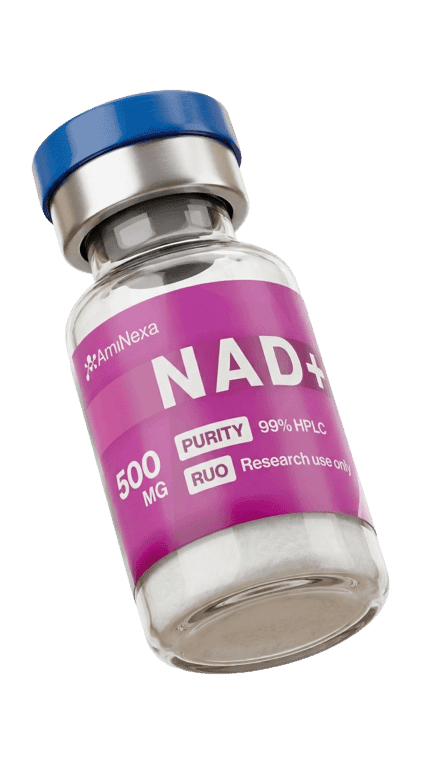
NAD⁺ Nicotinamide Adenine Dinucleotide
An essential dinucleotide coenzyme present in every living cell, critical for over 500 enzymatic reactions governing energy metabolism, DNA repair, and epigenetic regulation.
How NAD+ Works
Sirtuin Activation
NAD⁺ is the obligate substrate for sirtuins (SIRT1–7), a family of NAD-dependent deacetylases that regulate aging, inflammation, stress resistance, and metabolism. Without adequate NAD⁺, sirtuin activity declines, accelerating cellular aging.
DNA Repair via PARP
NAD⁺ fuels poly-ADP-ribose polymerases (PARPs), enzymes critical for detecting and repairing DNA single-strand breaks. Adequate NAD⁺ levels help maintain genomic integrity and cellular health throughout aging.
Mitochondrial Electron Transport
NAD⁺ is an essential electron carrier in the mitochondrial electron transport chain, directly driving ATP synthesis. Declining NAD⁺ impairs oxidative phosphorylation and contributes to age-related energetic dysfunction.
NAD⁺ decline creates a 'pseudohypoxic' state that disrupts mitochondrial-nuclear communication, contributing to age-associated metabolic dysfunction.
Clinical Research
Association of Human Whole Blood NAD⁺ Contents With Aging
Yang F, et al.
Blood NAD⁺ levels decline significantly with age — men show β = -1.12 in the 40–49 age group, becoming more pronounced after age 60 (β = -2.16). Validated by LC-MS/MS in a community-based cohort.
NAD⁺ and Sirtuins in Aging and Disease
Imai S, Guarente L
Established the NAD⁺-sirtuin axis as a central regulatory hub for metabolic homeostasis, demonstrating that NAD⁺ repletion restores sirtuin activity and reverses age-associated phenotypes in multiple model organisms.
NAD⁺ Homeostasis in Health and Disease
Katsyuba E, et al.
Comprehensive analysis of NAD⁺ biosynthesis, consumption, and recycling pathways, identifying therapeutic windows for NAD⁺ repletion strategies across metabolic, neurodegenerative, and cardiovascular disease models.
Research Applications
SIRT1–7 deacetylases
PARP-mediated repair
Electron transport chain
Cellular senescence
Molecular Profile
Safety Profile
NAD⁺ is an endogenous coenzyme with a well-established safety profile. IV administration studies report predominantly mild, rate-dependent effects that resolve with infusion adjustment.
Side effects are primarily related to infusion rate, not total dose
First session often produces stronger effects than subsequent sessions
Tolerance typically develops over repeated exposures
Slow infusion rate to reduce acute effects
Adequate hydration before and during administration
Pause infusion briefly if effects intensify, then resume at lower rate
Cardiac arrhythmias reported rarely in predisposed models
Severe hypotension (very rare)
Not evaluated in pregnancy or lactation models
Monitor cardiovascular parameters during high-dose protocols
Frequently Asked
Ready to begin research?
Access NAD+ through the AmiNexa catalog. All compounds ship via cold-chain transit with batch-specific Certificate of Analysis.
View NAD+ Product
Important Research Notice
Not for human consumption. This product is sold exclusively for research and educational purposes. It is not intended to diagnose, treat, cure, or prevent any disease.
All clinical trial data and research findings presented on this page are sourced from peer-reviewed journals and official publications. They are provided for educational reference only and should not be interpreted as medical advice or product claims.
By purchasing this product, you confirm that you are a qualified researcher and will use it in accordance with all applicable laws and regulations.